
NTJN Chemical · Product category

Nonionic Surfactants

Nonionic surfactants — Peregal, Span, Tween and PEG series.

20Product grades
2020Established
Nonionic Surfactants product line
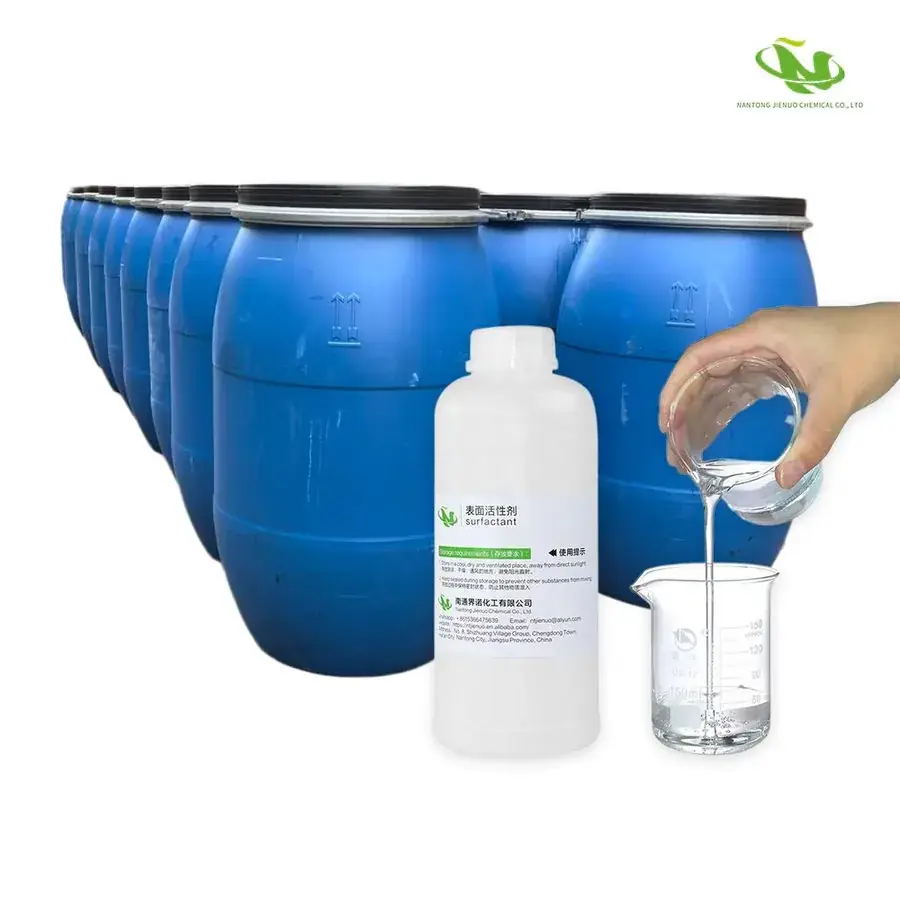
Nonionic Surfactants products & packaging

What are nonionic surfactants?

A nonionic surfactant carries no electric charge, so it stays compatible with anionic actives, electrolytes and hard water while providing wetting, emulsifying and levelling performance. For buyers the useful question is not just what nonionic surfactant means, but which HLB and chemistry fit your emulsion or cleaning system.

Because they are gentle and highly compatible, nonionic surfactants appear across cosmetics, textiles, agrochemicals and industrial processing. We help buyers shortlist nonionic surfactant examples and options before the first sample.

Common types of nonionic surfactants

Nonionic surfactants are grouped by their hydrophilic head. The series in our range are:

  • Sorbitan esters (Span) — lipophilic nonionics such as Span-80, a water-in-oil (W/O) emulsifier for cosmetics, food and industrial systems.
  • Polysorbates (Tween) — hydrophilic nonionics such as Tween-80, an oil-in-water (O/W) emulsifier and solubilizer for cosmetics, pharmaceutical and food systems.
  • Fatty alcohol ethoxylates — such as Levelling Agent O-25 (Peregal O-25) for dyeing levelling, and AEO-9 (C12-14 alcohol ethoxylate) for emulsification and detergent duty.
  • Polyethylene glycol derivatives — PEG-series nonionics for pharmaceutical, cosmetic and industrial roles.
  • Alkanolamides — such as Coconut Monoethanolamide (CMEA), a thickener and foam stabiliser for personal care washing products.

Where nonionic surfactants are used

Nonionic surfactants serve formulators in Southeast Asia, Europe, North America, India and the Middle East.

Because they tolerate hard water, electrolytes and pH swings, nonionic surfactants are a common first choice when a formula must stay stable across regions with very different water quality — a practical point for export brands standardising one formula for multiple markets.

Related products

The nonionic range spans levelling, emulsifying and solubilizing chemistries:

Levelling Agent O-25 (Peregal O-25) — representative imagery

Levelling Agent O-25 (Peregal O-25)

Levelling Agent O-25 (Peregal O-25) is a nonionic fatty alcohol ethoxylate widely used as a levelling agent in textile dyeing and as a general emulsifier and detergent auxiliary. It promotes even dye uptake, retards dye strike and improves levelness and compatibility in dye baths.

levelling agent O-25

Span-80 (Sorbitan Oleate) — representative imagery

Span-80 (Sorbitan Oleate)

Span-80 (sorbitan oleate, CAS 1338-43-8) is a lipophilic nonionic surfactant that functions as a water-in-oil (W/O) emulsifier. It conforms to HG/T 3508 as an amber viscous grease with hydroxyl value 190-220 mgKOH/g, saponification number 140-160 mgKOH/g, acid value <=8.0 mgKOH/g and water content <=1.5%, and is used in cosmetic, food and industrial W/O systems.

Span-80

Tween-80 (Polysorbate 80) — representative imagery

Tween-80 (Polysorbate 80)

Tween-80 (polysorbate 80, CAS 9005-65-6) is a nonionic surfactant that functions as an oil-in-water (O/W) emulsifier and solubilizer. It conforms to HG/T 3510 as an amber viscous grease with hydroxyl value 65-82 mgKOH/g, saponification number 43-55 mgKOH/g, acid value <=2 mgKOH/g and water content <=2%, and is used in cosmetic, pharmaceutical and food systems.

Tween-80

C12-14 Alcohol Ethoxylate AEO-9 — representative imagery

C12-14 Alcohol Ethoxylate AEO-9

AEO-9 is a C12-14 fatty alcohol polyoxyethylene ether nonionic surfactant with nine ethylene oxide units (HLB 13-14). It appears as a colorless-to-pale-yellow liquid or paste (Pt-Co <=30, 1% pH 5.0-7.0, cloud point 70-95 degC) and performs as an emulsifier, wetting agent and dispersant with strong detergency and hard-water resistance. It is widely used across cosmetic, detergent, textile, food-processing and pharmaceutical formulations.

AEO-9 fatty alcohol ethoxylate

Emulsifier EL-40 (PEG-40 Castor Oil) — representative imagery

Emulsifier EL-40 (PEG-40 Castor Oil)

Emulsifier EL-40 is PEG-40 castor oil - a nonionic surfactant made by ethoxylating castor oil with 40 moles of ethylene oxide (HLB 13-14, 1% cloud point 70-84 degC, pH 5.0-7.0, moisture <=1.0%). It is a light-yellow oily or creamy substance soluble in most organic solvents and dispersible in water, with strong emulsifying and diffusing action for textile, cosmetic and industrial systems.

emulsifier EL-40 PEG-40 castor oil

Coconut Monoethanolamide (CMEA, Cocamide MEA) — representative imagery

Coconut Monoethanolamide (CMEA, Cocamide MEA)

CMEA (Coconut Monoethanolamide, Cocamide MEA) is an alkanolamide nonionic surfactant made by amidation of refined coconut-oil fatty acid with monoethanolamine. It is a white-to-pale-yellow waxy flake at room temperature and works as a thickener, foam booster and foam stabiliser, compatible with anionic surfactants (SLS/SLES) for synergistic foam and viscosity in personal-care washing products.

coconut monoethanolamide CMEA cocamide MEA

Frequently asked questions

What is the difference between Span and Tween?

Span (sorbitan ester) is lipophilic and stabilises water-in-oil emulsions; Tween (polysorbate) is hydrophilic and stabilises oil-in-water emulsions. They are often used in pairs to tune emulsion stability and texture.

Can I request a nonionic surfactant sample before ordering?

Yes — free 500 g to 1000 g samples are available for evaluation. The buyer covers freight, and the sample value is deducted from a future bulk order.

Are nonionic surfactants compatible with anionic ingredients?

Yes — because nonionic surfactants carry no charge, they mix well with anionic actives and electrolytes, which is why they appear alongside anionic components in cleaning, cosmetic and textile systems.

Request a quote or technical sample

Share your application, target market and required volume — our team responds with selection and lead time.

Contact us